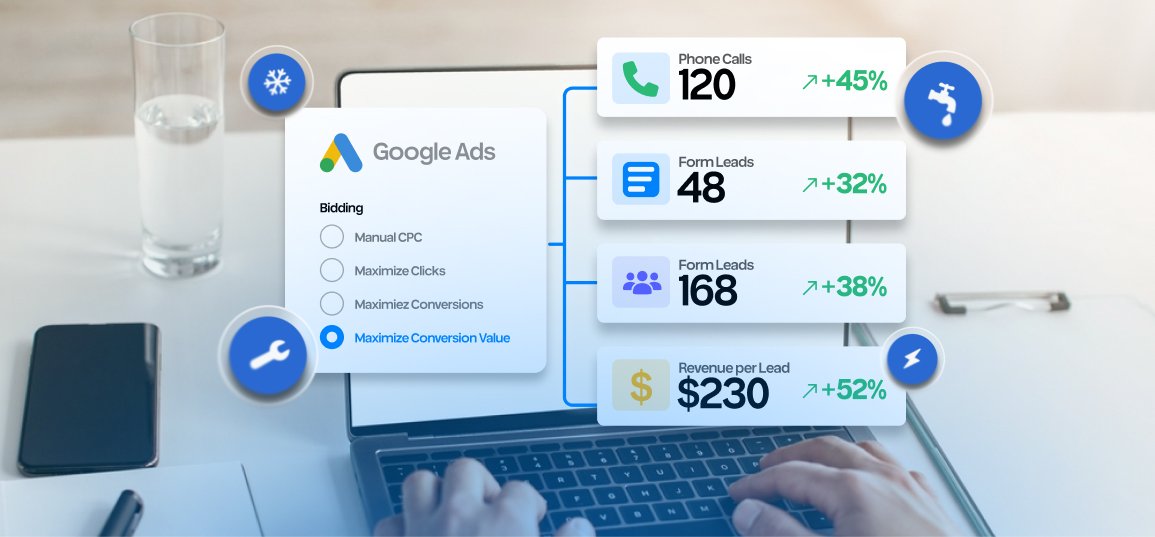












If your home-service business is fully booked, do not automatically shut off every Google Ads campaign. Reduce or redirect demand that cannot be served, keep profitable future work visible, and protect the parts of the account that take time to rebuild.
The core mistake is treating “fully booked” as a single business condition. You may be full for tune-ups this week but have installation capacity next month. One service area may be overloaded while another has idle technicians. Emergency calls may still deserve coverage even when routine work does not.
The goal is not to keep buying every lead. It is to match paid demand with the work the business can fulfill profitably.

Why pausing everything can create a second problem
A hard pause gives immediate budget relief, but it also removes the business from high-intent searches. When campaigns restart, demand, auction conditions, conversion volume, and bidding behavior may be different. The company can swing from too many leads to too few without a controlled middle ground.
This is the marketing version of feast or famine. The advertising account reacts to the current week, while hiring, dispatch, estimates, and sales operate on different timelines.
A better system looks ahead. It considers:
- Today’s open appointment slots
- The next two to six weeks of installation or project capacity
- Crew skills and service-line constraints
- Geographic travel time
- Expected cancellations and reschedules
- Close rates by lead source and service
- The value and urgency of each job type
When those inputs are visible, paid media becomes a demand valve rather than an on-or-off switch.
First, define what “full” means
Ask operations to quantify capacity before marketing changes the account.
For same-day repair businesses, capacity may mean dispatch slots by hour and ZIP code. For remodelers or roofers, it may mean estimate appointments now and production availability weeks later. For recurring cleaning, the constraint may be route density and crew hours.
Use three capacity states:
Open
The team can respond promptly, schedule the work within the expected window, and fulfill more of this job type. Campaigns can pursue profitable growth.
Constrained
Some capacity remains, but only for selected services, territories, days, or job values. Campaigns should narrow rather than disappear.
Closed
The business cannot meet the promise implied by the ad. Demand should be paused, redirected to future booking, or limited to services that remain fulfillable.
This shared language prevents a dispatcher saying “we are slammed” from becoming an account-wide shutdown with no distinction between tomorrow’s repairs and next month’s projects.
Five ways to control demand without going dark
1. Prioritize the services with the best capacity and economics
Separate emergency repair, routine maintenance, replacement, and large projects when their economics and scheduling needs differ. If repair slots are full but replacement consultations remain valuable, protect the latter.
Do not let a blended campaign decide how to allocate the last available dollars without business context. Feed marketing a weekly list of open, constrained, and closed service categories.
2. Tighten the service area
When crews are busy, long drive times become more expensive. Concentrating on dense, high-value territories can preserve revenue while reducing operational waste.
Use actual customer locations and job profitability, not a radius alone. A ZIP code that looks close on a map may create poor routing, while a slightly farther neighborhood near an existing route may be efficient.
3. Schedule call-focused ads for staffed hours
Google recommends scheduling ads that drive calls when someone is available to answer. If the business has no after-hours coverage, do not pay aggressively for urgent callers who will immediately try the next company.
That does not always mean turning off all search ads overnight. A landing page can set an honest response expectation and collect future-booking requests. The key is that the experience must match the user’s urgency.
4. Shift the offer from immediate service to future availability
For project-based work, the right message may be “schedule an estimate” rather than “get service today.” Make lead times visible before the form is submitted. This filters out people who cannot wait and reduces friction for prospects planning ahead.
Never advertise an immediate appointment when dispatch cannot deliver it. Short-term lead volume is not worth long-term reputation damage.
5. Keep remarketing and brand protection proportional
People who already know the company or have researched a high-consideration project may convert later. Maintain appropriate coverage where it supports future demand, while reducing the campaigns that create unserviceable immediate inquiries.
The exact mix depends on the service and privacy constraints. The principle is to preserve valuable demand without pretending capacity is unlimited.

A weekly capacity-to-campaign routine
Create a 20-minute meeting between marketing and operations. Use the same worksheet every week.
- List capacity by service and territory for the next six weeks.
- Flag the job types that are open, constrained, or closed.
- Compare booked-job value and close rate by campaign.
- Adjust budgets, schedules, locations, and messaging in a controlled set.
- Record the reason for each change and the date it should be reviewed.
Do not judge the result by lead count alone. Watch:
- Cost per qualified lead
- Cost per booked appointment
- Cost per sold job
- Average job value and gross profit
- Time to first response
- Days to next available appointment
- Cancellation and no-show rate
- Revenue by service area
These metrics reveal whether the account is producing useful demand or simply adding pressure to an overloaded team.
What if the business expects cancellations?
Many operators overbook because some customers cancel. That may be reasonable, but it should be based on a measured cancellation rate.
If 12 percent of estimates cancel with at least 24 hours’ notice, marketing and scheduling can maintain a controlled buffer. If cancellations happen at the door or crews routinely run late, buying extra demand may worsen customer experience.
Use automated confirmations, reminders, and waitlists to reclaim capacity before increasing media spend. The cheapest appointment is often the one you prevent from disappearing.
What clean lead data changes
Capacity decisions are only as good as the conversion data behind them. A home-improvement company in a White Shark Media case study appeared to generate 58 to 82 monthly conversions, but the reporting included bots and low-quality actions. After tracking cleanup, bot controls, location cleanup, and a shift toward qualified opportunities, the account produced 30 to 43 real qualified leads per month and reduced reported cost per conversion from roughly $519 to $195 over the documented period.
The lesson is not that every home-service account will produce those results. It is that a full calendar built on bad lead counts is not the same as profitable capacity. Marketing needs to know which inquiries become real opportunities.
When a complete pause is reasonable
A full pause can be appropriate when:
- The company cannot deliver the advertised service at all
- Severe weather, supply constraints, licensing, or staffing makes fulfillment unsafe or impossible
- The intake team is unavailable and no honest alternative path exists
- Tracking is broken badly enough that continued automated optimization would reinforce false signals
- The business is closing or leaving a market
Document the reason, preserve historical settings, and define a restart condition. “Turn it back on later” is not a plan. “Restart the replacement campaign when installation capacity falls below 80 percent for the next four weeks” is.
Frequently Asked Questions
Will pausing Google Ads hurt campaign learning?
Reactivated automated campaigns may need time to recalibrate, especially when conversion volume is low or the market changed during the pause. The business impact depends on campaign structure, bidding, pause length, and data quality.
How much should I cut the budget when booked out?
There is no universal percentage. Cut enough to stop buying work you cannot serve, while preserving profitable future demand. Base the change on capacity by service and territory rather than an arbitrary rule.
Should I keep ads running after hours?
Only when the experience matches the need. Urgent call ads should run when someone can answer or a reliable answering service can qualify and route the call. Future-booking forms can remain available with clear response times.
Can I advertise a waitlist?
Yes, when the expected timing is honest and the economics justify it. A waitlist works better for planned projects and recurring services than for emergencies.
Build demand around the calendar you actually have
The best home-service campaigns do not maximize leads in isolation. They create the right demand, in the right place, for the work the team can deliver.
If your calendar and ad account keep fighting each other, book a growth session with White Shark Media to review where demand, tracking, and operational capacity are out of sync.